System’s Destruction of Sydea
Systema Delenda EstSystem’s Destruction of Sydea names the System’s prolonged destruction of a once-flourishing world and the crisis that finally exposes that destruction to Sydea’s own people. Rather than arriving as one isolated blow, it unfolds through demographic decline, lost towns, cultural erasure, restricted settlement, weaponized ruins, and the replacement of native autonomy with System-managed survival. Cato’s intervention gives the process a second, more literal ending: when he removes the remaining System anchor, the world undergoes a terrifying physical transformation as System-supported environments fail and ordinary biology begins to return.
Causes and Historical Background
Before the System came, Sydea possessed a worldwide civilization capable of supporting hundreds of millions of people. Its inhabitants built cities, sculpture, architecture, and infrastructure that exceeded anything the System later granted them. Cato demonstrates this history to Raine and Leese through recovered evidence, including a Sydean sculpture retrieved from a sunken city: a figure with its tail coiled around its ankles and its hands raised beseechingly. The object is not merely an archaeological curiosity. It proves that Sydea once produced its own art and possessed a cultural world that the System’s settlements have made almost invisible.
The System’s arrival interrupted Sydea before its society had developed the agricultural and political foundations that might have enabled resistance. Initik remembers the moment not as an apocalypse but as a hunt. He was pursuing prey when the System’s words appeared before him and became understandable; afterward, he and his people no longer had to wander the plains in search of food. Initik’s recollection suggests that the System reached Sydea during, or even before, the species’ transition into settled agriculture. It supplied immediate security while preventing the deeper process of land-taming, cultivation, and self-directed development that would have allowed Sydeans to shape their own future.
The resulting domination is structural rather than merely military. Over the century before Cato’s arrival, Sydea’s population shrinks, towns disappear, and wilderness closes in. The System selects where towns and cities may stand, determines when they may expand, and fixes the cost of expansion. It will not permit Sydeans to tame the wilds, excavate a promising site, or build according to their own priorities. Their apparent stagnation is therefore misdiagnosed as weakness or failure. Cato insists that Sydea is not naturally dying; it is being killed by the rules imposed upon it.
What the Destruction Looks Like
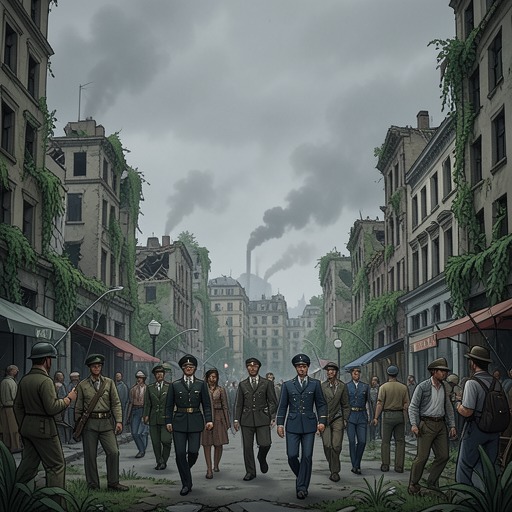
The demographic decline is visible in the landscape. Cato identifies nearly a hundred cities of different sizes that were clearly built by Sydea’s ancestors, alongside several dozen settlements that were brought to the planet or grown there by the System. The distinction is not always easy to make because the ruins are old, altered, and embedded in System territory, but the scale of the surviving remains reveals how much has been lost. The present towns, by contrast, are bounded and regulated, their possibilities narrowed to whatever the System recognizes as a viable settlement.
The ancient cities have also been converted into instruments of the System’s economy and violence. Cato shows Arene an underwater Conflict Zone containing curving domes, fluted columns, and faded carvings. Sydeans once moved thousands of tons of stone, shaped it precisely, and set it into structures that stood for centuries, using no more strength than the lowest System rank. The System has taken those cities and turned them into homes for monsters. A civilization’s architectural inheritance thus becomes a dungeon-like resource and a hostile environment, while the descendants of its builders are confined to smaller, poorer, System-approved settlements.
The destruction is also cultural. Cato observes that he has not seen a single painting or sculpture of Sydean origin in the towns and cities he visits, despite the evidence of a former civilization that produced art on a large scale. The absence matters because the System does not simply occupy Sydea’s built environment; it displaces the memory of what Sydeans were capable of. Its white, standardized buildings stand against native colors, and the few inhabitants who spend System currency to recolor a shop or house offer only minor personal modifications within an otherwise imposed visual order.
Sydea’s social isolation is intensified by the System’s species-spanning but culture-flattening framework. Cato encounters a world in which most visible inhabitants are lizard-people, with smaller populations of crab-people, bird-people, rock-people, and other broadly humanoid forms. The System gives them a shared game-like language and common institutions, but not the technological culture or accumulated simulated history associated with postbiological life. To Cato, this makes Sydea both familiar and radically alien: the System can imitate technology while denying the cultural depth that technology once enabled.
The Revelation to Sydea’s Defenders
Cato’s campaign becomes politically consequential when he explains Sydea’s condition to Raine, Leese, Arene, and Onswa. His motive begins with Earth, or Ahrusk in the System’s terminology. When the System arrived there, it destroyed entire worlds, killed people Cato loved, and twisted others beyond recognition. Earth was eventually freed by scattered postbiological humans, but Cato considers that liberation incomplete while the System survives elsewhere and retains the ability to return.
Cato does not ask Sydeans to accept his cause merely because Earth suffered. He argues that the same mechanism is operating on Sydea. When Raine objects that the System did not directly kill the group that attacked them, Cato distinguishes the immediate incident from the larger historical crime: the System aimed them at him, and it has been destroying their world on a far greater scale. Arene finds the argument persuasive even while recognizing how dangerous and seemingly mad it is. After a century and more of failed efforts to reverse Sydea’s decline, an outside power that identifies the System as the cause becomes both a threat and a possible answer.
The revelation also changes the meaning of Cato’s apparent invasion. Muar describes him as an invader and conqueror, claiming that Raine has sold herself for hollow rewards. Cato is not entirely disinterested, and his methods are undeniably coercive, but the accusation cannot erase the material evidence of Sydea’s decline. The conflict therefore turns on competing definitions of invasion. Cato crosses a portal into Sydea, yet the System had already invaded its history, land, cities, economy, and future; Cato’s claim is that removing that older occupier is an act of liberation rather than a new conquest.
Collapse of the System Anchor
The most direct stage of System’s destruction occurs when Cato extracts and maps the System Interface embedded in the gem at Onswa’s office. The Interface had been driven into a state of overdrive by the surrounding disruption, making its structure easier to reproduce through mindripper software. Once Cato has a workable emulation, he is able to destroy the city anchor. The System-God’s anchor had been the last remaining anchor on Sydea, but the deity in charge had abandoned it, leaving the consequences uncertain.
The result is not a clean return to an untouched pre-System world. Every other town loses power, or more precisely, loses essence, the System’s catchall resource. Lights go out and stores shut down. As the System withdraws, regions that had seemed natural reveal themselves as System-supported constructions. Mountains crumble or vanish, broad lakes become muddy plains, and storms appear and disappear with chaotic violence. Grasslands shift toward native life while alien forests wither. Invasive monsters vanish abruptly, like effects removed from a display, but transplanted organisms also die in place, leaving scars that will endure for years or decades.
Raine and Leese witness the transformation from both orbital and local perspectives. A small change of color on the planetary view corresponds to the replacement of everything a warframe can see below. The scale is difficult for either human or Sydean minds to comprehend, because the event is simultaneously planetary and intimate: whole biomes alter while individual towns lose the infrastructure that made ordinary life possible. Sydea’s liberation therefore carries the immediate appearance of apocalypse. Cato destroys the System’s support, but he must also replace it with biological factories and technological infrastructure if the population is to survive the transition.
Consequences and Wider Significance
Sydea becomes the first major demonstration that removing the System can be more dangerous than simply fighting its agents. Cato’s objective is not only to destroy anchors but to cushion their loss with technological equivalents and to find trustworthy natives capable of managing the transition. His loneliness complicates that plan. He is the only human present, while Sydeans are neither human nor postbiological, and their institutions do not share the accumulated cultural experience from which he draws. He must therefore reconstruct a world for people whose psychology and history he cannot fully judge.
The event establishes a recurring pattern for later worlds. When the System collapses on Heyk, massive flora die-offs threaten oxygen levels, while the absence of native bacteria capable of breaking down alien biomatter leaves dead vegetation to accumulate instead of decaying. Cato’s forces must intervene at the level of atmosphere, decomposition, crops, and basic planetary metabolism. Sydea shows the first version of this problem: System withdrawal restores some ordinary physics and native ecology, but it also exposes dependencies that had been hidden by System regulation.
The political consequences extend beyond Sydea. Later powers debate whether worlds should be isolated, portals closed, and teleportation blocked after witnessing the destruction of a System-controlled planet. Core powers have sometimes destroyed individual worlds, but the destruction of whole inhabited planets on a broader scale is treated as an exceptional and alarming development. As Cato’s forces spread through the Inner Worlds, the possibility that every world is compromised makes planetary liquidation appear both tempting and politically dangerous. Sydea thus becomes evidence in an argument over whether the System can be reformed, contained, or only dismantled.
The event also exposes the hierarchy hidden behind the System’s apparently universal rules. Initik and Mii-Es cannot fully explain what the highest authorities can do because ordinary World Deities do not possess the same interface as Core Deities. Cato concludes that System extermination must originate from a superuser level and suspects that many supposedly fixed benefits, including resurrection, can be adjusted by sufficiently powerful administrators. Sydea’s destruction is therefore not just a local tragedy; it reveals that the System is a layered political and technical structure whose deepest controls remain beyond the reach of most of its inhabitants.
Sydea’s System apocalypse is finally significant because it reverses the moral surface of the game-like world. The System presents itself as the provider of food, safety, settlements, ranks, and civilization, yet its gifts conceal the loss of autonomy, memory, ecological knowledge, and historical possibility. Cato’s intervention replaces one catastrophe with another: the System’s controlled stagnation ends, but the world is left to survive the violent return of reality. The event makes liberation inseparable from reconstruction, and turns the destruction of an oppressive system into a question of who can preserve the people living inside it.